


How CRM Software Can Help Real Estate Companies Increase Lead Conversion?
Every property inquiry is a potential sale—but only if it’s managed at the right time. Most real estate businesses receive leads from websites, Google Ads, Meta Ads, WhatsApp, and property portals, yet many opportunities are lost because follow-ups are delayed or scattered across different tools.
A CRM Software for Real Estate centralizes lead capture, qualification, follow-ups, sales pipelines, and reporting into one intelligent system, helping your team convert more inquiries into qualified customers and close deals faster.

Why Real Estate Leads Get Lost?
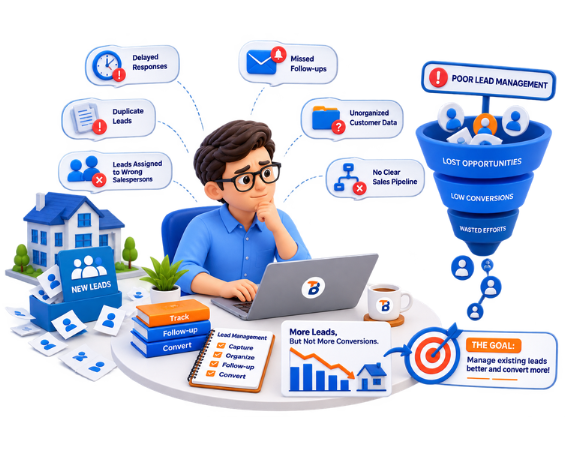
Every property inquiry is a potential sale—but only if your team responds and follows up consistently. Most real estate companies receive leads from websites, Google Ads, Meta Ads, WhatsApp, and property portals, yet opportunities are often lost because the sales process is scattered.
The biggest reasons leads are lost:
The biggest reasons leads are lost:
- Delayed responses
- Missed follow-ups
- Duplicate lead entries
- Unorganized customer data
- Wrong salesperson assignment
- No clear sales pipeline
What is CRM-Based Lead Conversion?
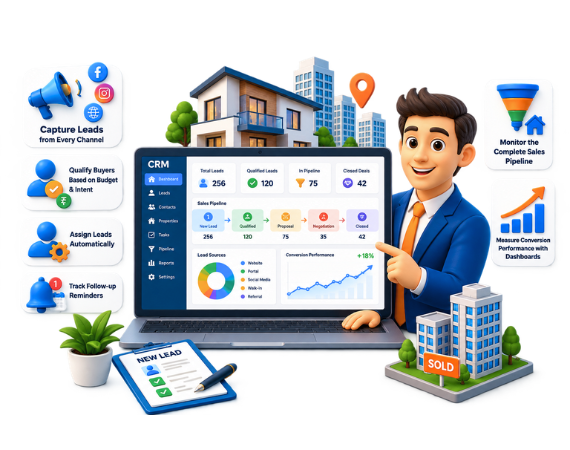
A CRM Software for Real Estate connects lead capture, qualification, follow-ups, sales pipelines, and reporting into one intelligent system. Instead of managing buyers across spreadsheets and WhatsApp chats, every interaction stays organized in one place.
A Real Estate CRM helps you:
A Real Estate CRM helps you:
- Capture leads from every channel
- Qualify buyers based on budget & intent
- Assign leads automatically
- Track follow-up reminders
- Monitor the complete sales pipeline
- Measure conversion performance with dashboards

The Core Steps at a Glance
Lead Capture
Capture inquiries from websites, Google Ads, Meta Ads, WhatsApp, property portals, phone calls, and landing pages in one centralized CRM.
Lead Qualification
Identify high-potential buyers using property type, location preference, budget, buying timeline, and financing requirements.
Lead Assignment
Automatically assign every inquiry to the right salesperson, ensuring faster response times and zero missed opportunities.
Follow Up and Conversion
Automate reminders, schedule site visits, and nurture prospects through every stage until they become customers.
What Should a Real Estate CRM Include?
A successful Real Estate CRM is much more than a contact management tool. It centralizes lead capture, buyer information, follow-ups, sales pipelines, reporting, and automation into one connected platform. By bringing every customer interaction into a single system, your sales team can respond faster, prioritize high-value opportunities, and manage the complete journey from inquiry to booking.
Why CRM Alone Isn't the Solution?
Buying CRM software doesn’t automatically increase lead conversion. The real advantage comes from having a clear and repeatable sales process before introducing automation. Your business should define where leads come from, who qualifies them, who receives them, how quickly they should respond, and when a lead is considered lost.
Once these rules are established, CRM automation makes your entire sales workflow consistent, measurable, and easier to scale across multiple projects and sales teams.
When Does Custom CRM Make Sense?
A standard CRM may work for simple sales processes, but growing real estate businesses often need workflows designed around their own operations. Features like custom lead assignment, multiple projects, WhatsApp integration, property portal connectivity, automated workflows, and CRM–ERP integration require a more flexible solution.
Custom CRM Development allows the software to adapt to your business instead of forcing your team to change the way they work.
How to Measure CRM Success?
The success of a real estate CRM shouldn’t be measured by the number of leads alone. Businesses should focus on meaningful performance metrics such as lead response time, qualified lead rate, follow-up completion, site visit rate, conversion rate, sales cycle length, and lost lead reasons.
Tracking these KPIs helps identify where your sales process is performing well and where valuable opportunities are being lost.
Tracking these KPIs helps identify where your sales process is performing well and where valuable opportunities are being lost.
Final Thoughts
CRM software isn’t simply a place to store customer information—it’s a system that ensures the right lead receives the right attention at the right time. From capturing inquiries and qualifying buyers to assigning leads, scheduling follow-ups, and tracking conversions, every stage becomes structured and measurable.
When these processes work together, real estate companies reduce missed opportunities, improve team productivity, and create a predictable sales pipeline.
When these processes work together, real estate companies reduce missed opportunities, improve team productivity, and create a predictable sales pipeline.
Ready to Turn More Real Estate Leads Into Customers?
BreezewayTech builds Custom CRM Solutions with lead management, automated follow-ups, sales pipelines, dashboards, and business integrations.
Build a CRM around the way your real estate business actually works.